Since Boats Do Not Have Brakes, What Is the Best Way to Bring Your Boat to a Stop?
So: you haven't endemic a boat earlier, but after discovering that the canoeing lifestyle is totally awesome (nosotros agree!) you've began exploring our Boat Finder Tool—and luckily, you've plant the ideal boat for you and your family unit. You're probably thinking that your adjacent big challenge will be learning how to drive that boat—and you're right—but don't let the prospect feel daunting.
Think the outset time yous sabbatum behind the cycle of a car? You may take experienced a bit of trepidation then, too. But you probably got over it in short order, and driving became second nature before you knew it. In all likelihood, you'll have a like experience equally you larn how to bulldoze your boat.
To get started, let's eddy it all down to the basics when it comes to learning how to drive a gunkhole.
How to Drive a Gunkhole
- If your boat is powered by gasoline and has an engine compartment, run the "blower" (an exhaust fan) for four minutes as per manufacturer's recommendations prior to starting the engine, to make certain at that place isn't a build-up of fumes in the compartment. This is a good time to run through your Pre-Divergence Checklist.
- Put the key into the ignition (some modern boats have button-buttons instead), and turn it to kickoff the engine.
- If the boat has a "impale switch" (also known every bit an engine safety cutting-off, which automatically turns the engine off if you exit the helm for whatsoever reason), clip the lanyard on a belt loop of life jacket ring. This is required past U.Due south. Coast Guard law.
- Make certain all your gear is aboard and all your passengers are prepared to disembark.
- Remove all the lines securing the boat to the dock, pier or slip.
- Appoint forward (or reverse if you lot need to back out of a slip) by pushing the throttle handle forward (or pulling information technology back) gently until y'all feel it shift into gear.
- When the gunkhole begins moving, spin the cycle just every bit you lot would turn the steering wheel in a car to determine management of travel.
- Advance the throttle equally appropriate to reach the desired speed.
- Trim (accommodate running attitude) the gunkhole as appropriate for the conditions.
- When you want to slow downward, gently pull the throttle dorsum towards the neutral position.
How to Become a Boating License
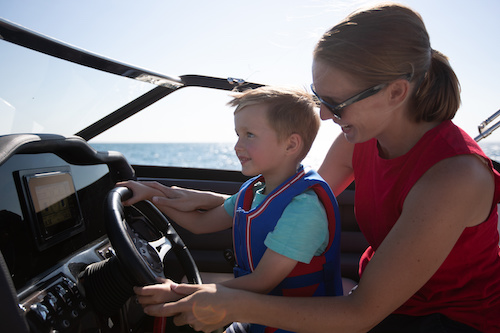
How to Offset a Gunkhole
Starting a boat is as uncomplicated equally turning the key, but there are a few rubber items you need to exist aware of which aren't present in automobiles and which may prevent the engine from turning over.
Engine Safety Cut-Off or "Impale Switch"
The first prophylactic particular that'due south important to annotation is ane nosotros mentioned above: the kill switch, or engine safe cut-off. This is a small red knob found next to the ignition on nigh small or open boats. In the closed position, the switch won't permit the engine to start. A small clip fitted to slide under the knob pulls it back, into the open position. This clip is attached to a lanyard, which has a tether clip on the other end.You lot should ever clip this onto a loop on your lifejacket or a belt loop, prior to operating your gunkhole. Then, if for whatsoever reason yous move abroad from the helm, the lanyard yanks the clip out from under the knob and the engine immediately stops.
Gunkhole Engine Cut-Off Switch (ECOS): Understanding the Basics
Throttle
Another safety feature that tin prevent a gunkhole engine from starting is the throttle, which must be in the neutral position. If the gunkhole battery is turned on and fully charged, you lot turn the fundamental, and the engine doesn't get-go, it's often because the kill switch is engaged or the throttle isn't in neutral.
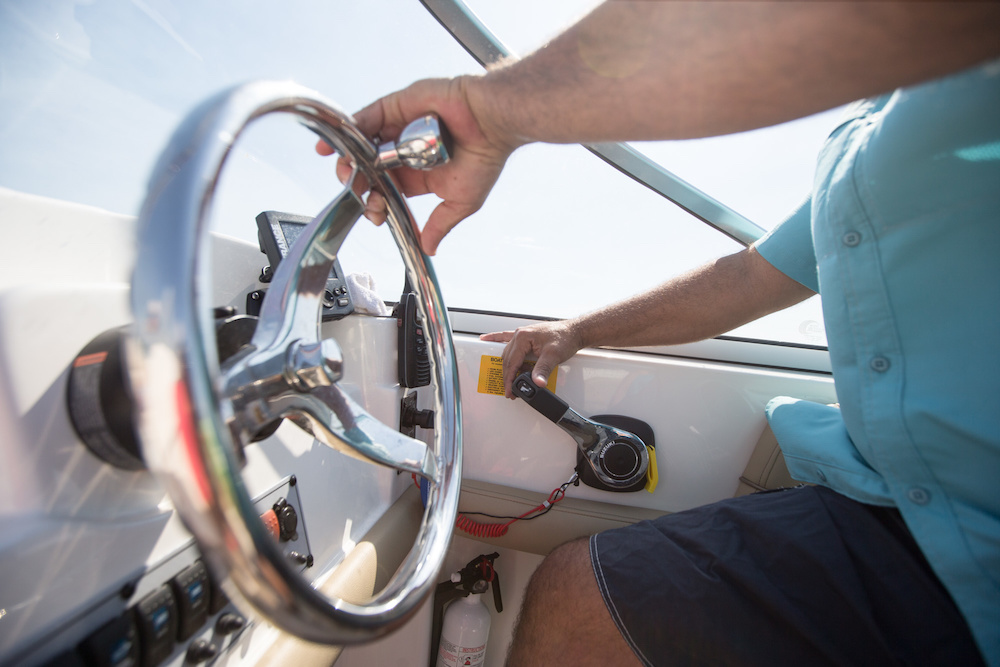
Operating the Gunkhole's Throttle
Recall of a gunkhole'south throttle just like the accelerator pedal in a auto. Unlike a car, however, once you accommodate it to a specific speed it stays there. And then slowing down requires more than simply taking your foot off a pedal, you accept to actually grasp the throttle and pull information technology back. This is important to proceed in listen, because when you see a big wave or lots of traffic coming, you need to be prepared to movement the throttle appropriately.
This brings up an important betoken we haven't covered just yet: situational awareness. When driving whatever motorized vehicle information technology's of import to constantly monitor your surround for anything that might require a response—a traffic light, pedestrians, other vehicles, and then on. The same is true when you're operating a gunkhole. In boating terms this is referred to equally "maintaining a proper lookout man," and it means that as the captain of a gunkhole, you have to always be watching your surroundings and recognize when at that place'due south a hazard of collision, running aground, hitting a big wave, or whatsoever other factor that could require a response at the helm.
Steering a Boat
As we pointed out, using a steering wheel on a boat is very similar to using a steering wheel in an motorcar. You turn the wheel, and the boat follows—mostly.
Y'all demand to always recollect that at that place are other factors influencing a gunkhole's direction of travel, like air current, waves, and current. As a issue, boats may handle differently in dissimilar conditions and a plow of the cycle may non ever change the gunkhole's direction exactly as planned. This can exist particularly frustrating when docking, which many new boaters describe as 1 of the most challenging maneuvers to learn. So before you give it your first shot written report up on the process, by reading Docking a Boat: a Stride-by-Step Guide.
One time you have steering and docking downwardly pat, y'all may exist tempted into making long cruises to distant ports, or fishing hotspots that are beyond eyesight of the marina. To go there and back safely, you'll need to take some other big footstep in your boating career and learn how to navigate a boat.
Understanding Canoeing Rules of the H2o
Slowing a Gunkhole
We already mentioned that you have to dispense the throttle to go a boat to slow downward, simply since boats don't have brakes, there'south a bit more yous demand to know.
- For starters, you lot need to go familiar with your boat and acquire how much stopping altitude is needed to come to a complete finish in a safe fashion when running at different speeds.
- Remember, boats don't have seatbelts and are subject to a lot more movement than land vehicles. Equally a consequence, sudden or abrupt changes in speed or direction tin can throw people off balance or fifty-fifty cause them to fall overboard.
- Always be conscious of how you adjust speed or turn. In cases of quick maneuvers, when possible you'll also want to shout out a warning to your passengers so they know to hold on.
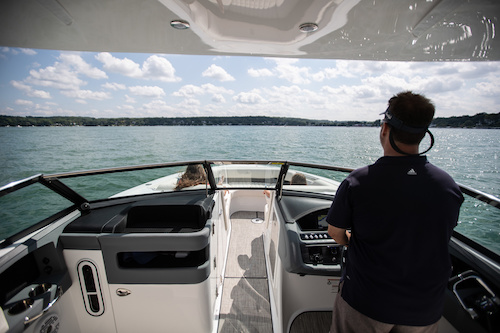
All of that said, you can wearisome a boat fastest past:
- first pulling the throttle back to neutral;
- pausing for a moment;
- then shifting into reverse and applying some ability.
Think to e'er pause in neutral and don't shift directly from frontward into opposite, considering quickly shifting from 1 to the other tin can cause mechanical impairment in some boats.
It's as well important to note that at that place are many other aspects to driving a boat that chronicle to the safe of you and your passengers. That's why most states require you to take a basic boating safe course before running your own boat. But on top of that, prior to operating one we strongly recommend visiting our Safety Guide and giving it a thorough read.
How to Trim a Boat
With the basics under your belt, you lot'll desire to learn some of the finer points of driving a boat that volition assist it run smoother and more than efficiently. One of import item to learn is how to trim a boat. Trimming consists or manipulating the outdrive's angle or deploying "trim tabs" (small plates on the stern of the boat).
- How you lot trim information technology determines how high the bow rises in relation to the stern, and how level the gunkhole does or does non run.
- Trim is different on every boat, so trial and error is the all-time fashion to larn how your own boat responds to changes in bulldoze bending and/or using tabs.
- As well keep in mind that on smaller boats, shifts in weight distribution (such as a rider moving from one expanse of the boat to another) tin crusade changes in trim.
Acquire More: How to Trim a Boat
Driving Dissimilar Types of Boats
All gunkhole models are more or less unique, but a few require some special attention. Pontoon boats, for case, have some unusual traits. So for people getting a 'toon, we've got a How to Drive a Pontoon Gunkhole article only for you. And apparently sailboats are very different from powerboats. If you're virtually to become a sailor, be sure to check out Learning the Basics of Sailing.
One terminal discussion of advice: remember that all boats are dissimilar, and information technology takes some practice to learn how to drive any boat—even Captain Ahab would need to re-learn a thing or two when taking the captain of a new vessel. So don't be discouraged if you hitting a speed-bump or ii equally you learn how to run your boat. Because before y'all know information technology, driving it will become second nature.
Read Adjacent: How to Drive a Pontoon Boat
Y'all Might Also Like:
- How to Launch a Boat
- How to Anchor a Boat
- How to Tie Upwardly a Boat
- All-time Boats for Beginners
- Find the Right Gunkhole for Your Lifestyle
Source: https://www.discoverboating.com/resources/how-to-drive-a-boat
0 Response to "Since Boats Do Not Have Brakes, What Is the Best Way to Bring Your Boat to a Stop?"
Publicar un comentario