How to Know if My Unborn Baby Has Birth Defects
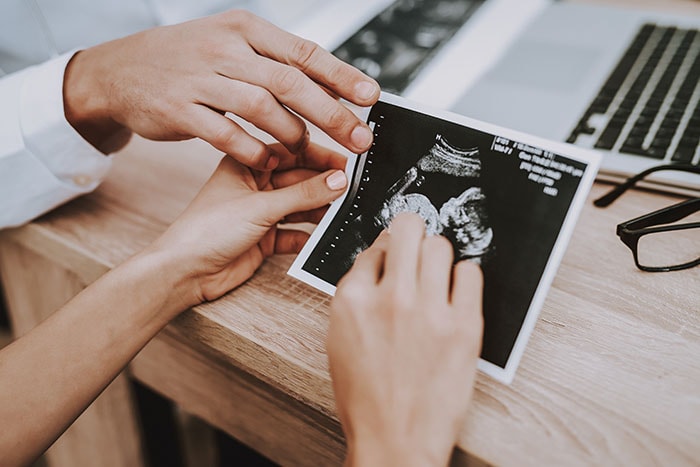
Nascence defects can exist diagnosed during pregnancy or later on the baby is born, depending on the specific type of birth defect.
During Pregnancy: Prenatal Testing
Screening Tests
A screening test is a process or test that is done to meet if a woman or her babe might have certain problems. A screening test does not provide a specific diagnosis—that requires a diagnostic test (run into below). A screening test can sometimes give an aberrant result even when there is nothing incorrect with the mother or her baby. Less often, a screening test effect can be normal and miss a problem that does exist. During pregnancy, women are ordinarily offered these screening tests to check for nativity defects or other issues for the adult female or her baby. Talk to your doctor about whatsoever concerns you take nigh prenatal testing.
First Trimester Screening
First trimester screening is a combination of tests completed between weeks 11 and 13 of pregnancy. It is used to look for sure birth defects related to the babe's heart or chromosomal disorders, such as Down's syndrome. This screen includes a maternal blood test and an ultrasound.
- Maternal Blood Screen
The maternal claret screen is a simple claret exam. It measures the levels of two proteins, man chorionic gonadotropin (hCG) and pregnancy associated plasma protein A (PAPP-A). If the protein levels are abnormally high or low, at that place could be a chromosomal disorder in the baby.
- Ultrasound
An ultrasound creates pictures of the baby. The ultrasound for the outset trimester screen looks for actress fluid behind the infant's neck. If there is increased fluid found on the ultrasound, there could exist a chromosomal disorder or heart defect in the baby.
Second Trimester Screening
Second trimester screening tests are completed between weeks 15 and 20 of pregnancy. They are used to look for certain nascency defects in the baby. 2nd trimester screening tests include a maternal serum screen and a comprehensive ultrasound evaluation of the baby looking for the presence of structural anomalies (also known every bit an anomaly ultrasound).
- Maternal Serum Screen
The maternal serum screen is a unproblematic claret test used to place if a woman is at increased risk for having a babe with certain nascence defects, such as neural tube defects or chromosomal disorders such equally Down syndrome. It is also known every bit a "triple screen" or "quad screen" depending on the number of proteins measured in the mother'due south blood. For case, a quad screen tests the levels of 4 proteins AFP (alpha-fetoprotein), hCG, estriol, and inhibin-A. By and large, the maternal serum screen is completed during the second trimester.
- Fetal Echocardiogram
A fetal echocardiogram is a exam that uses sound waves to evaluate the babe's middle for heart defects before nativity. This test can provide a more than detailed image of the babe'southward centre than a regular pregnancy ultrasound. Some eye defects can't exist seen earlier nativity, even with a fetal echocardiogram. If your healthcare provider finds a trouble in the structure of the infant's middle, a detailed ultrasound may exist washed to look for other issues with the developing baby.
- Bibelot Ultrasound
An ultrasound creates pictures of the baby. This test is usually completed effectually 18–20 weeks of pregnancy. The ultrasound is used to check the size of the baby and looks for nascence defects or other problems with the babe.
Diagnostic Tests
If the upshot of a screening test is aberrant, doctors unremarkably offering further diagnostic tests to determine if birth defects or other possible bug with the babe are nowadays. These diagnostic tests are also offered to women with college risk pregnancies, which may include women who are 35 years of age or older; women who accept had a previous pregnancy affected by a nascence defect; women who take chronic diseases such every bit lupus, high claret pressure, diabetes, or epilepsy; or women who use sure medications.
High resolution Ultrasound
An ultrasound creates pictures of the baby. This ultrasound, also known as a level 2 ultrasound, is used to look in more detail for possible birth defects or other problems with the baby that were suggested in the previous screening tests. It is usually completed between weeks 18 and 22 of pregnancy.
Chorionic Villus Sampling (CVS)
CVS is a test where the medico collects a tiny piece of the placenta, called chorionic villus, which is then tested to check for chromosomal or genetic disorders in the infant. Generally, a CVS test is offered to women who received an abnormal upshot on a starting time trimester screening test or to women who could be at higher risk. It is completed betwixt 10 and 12 weeks of pregnancy, before than an amniocentesis.
Amniocentesis
An amniocentesis is exam where the physician collects a pocket-sized amount of amniotic fluid from the area surrounding the infant. The fluid is so tested to measure out the baby's poly peptide levels, which might point certain birth defects. Cells in the amniotic fluid can be tested for chromosomal disorders, such as Down syndrome, and genetic problems, such as cystic fibrosis or Tay-Sachs disease. Mostly, an amniocentesis is offered to women who received an aberrant consequence on a screening test or to women who might be at higher risk. It is completed betwixt xv and 18 weeks of pregnancy. Below are some of the proteins for which an amniocentesis tests.
- AFP
AFP stands for alpha-fetoprotein, a protein the unborn baby produces. A high level of AFP in the amniotic fluid might mean that the baby has a defect indicating an opening in the tissue, such as a neural tube defect (anencephaly or spina bifida), or a body wall defect, such as omphalocele or gastroschisis.
- AChE
AChE stands for acetylcholinesterase, an enzyme that the unborn baby produces. This enzyme can pass from the unborn baby to the fluid surrounding the baby if there is an opening in the neural tube.
After the Baby is Born
Certain birth defects might non be diagnosed until after the baby is built-in. Sometimes, the nativity defect is immediately seen at birth. For other birth defects including some heart defects, the birth defect might not be diagnosed until afterwards in life.
When there is a wellness problem with a child, the primary care provider might wait for nativity defects by taking a medical and family history, doing a concrete exam, and sometimes recommending further tests. If a diagnosis cannot be made later the exam, the primary care provider might refer the child to a specialist in nascence defects and genetics. A clinical geneticist is a dr. with special preparation to evaluate patients who may take genetic weather or birth defects. Even if a child sees a specialist, an verbal diagnosis might not be reached.
Source: https://www.cdc.gov/ncbddd/birthdefects/diagnosis.html
0 Response to "How to Know if My Unborn Baby Has Birth Defects"
Publicar un comentario