Make America Think Again Green Party
Many Americans value environmental protection and want to see more of it. Simply Jill Stein, the Green Party presidential candidate, is drawing but 1 to 3 percent in contempo polls, even in an election where many voters dislike the major candidates and are looking for alternatives.
Stein certainly has worked to differentiate herself from the ii major party candidates. In July she asserted that electing Democratic nominee Hillary Clinton – probably the selection of most pro-environment voters – would "fan the flames of … right-wing extremism," and be as bad as electing Donald Trump.
While Stein makes anti-institution statements similar this, her German language counterparts have been advancing a dark-green agenda in local, regional and national regime for the past 30 years. Virtually recently, Winfried Kretschmann was reelected this year as head of government in Baden-Württemberg, one of Europe's technologically and industrially most advanced regions.
I grew up in Germany and have taught about Germany and Europe in the United states for the past 15 years, and so I have seen Green Political party politicians at piece of work in both countries. In my view, there are two reasons why the U.S. Light-green Party remains then marginal. Structurally, the American electoral system is heavily weighted against modest political parties. But U.S. Greens likewise harm themselves past taking extreme positions and failing to empathize that governing requires compromise – a lesson their German counterparts learned several decades ago.
One movement, two electoral systems
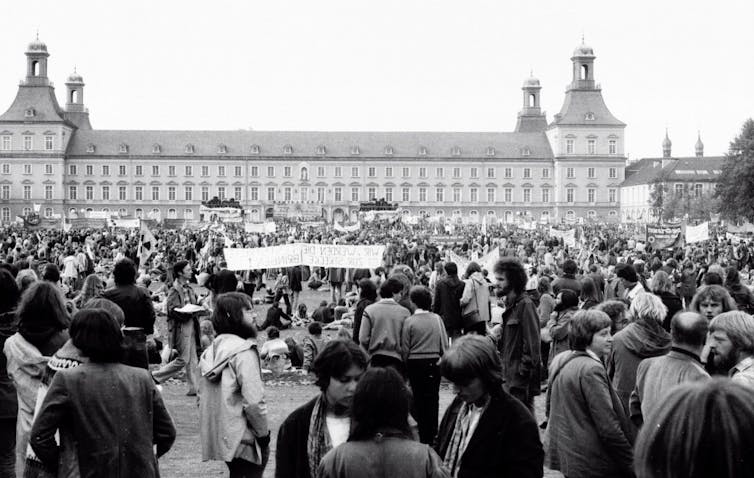
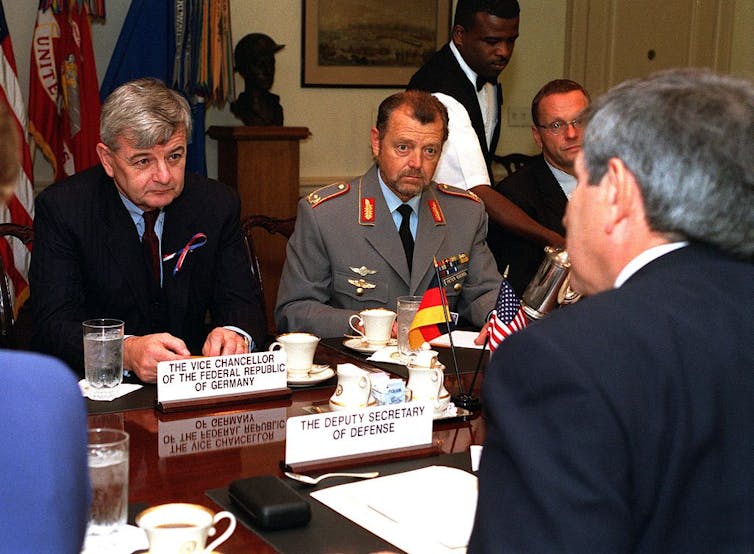
Both European and North American Green Parties evolved from activist movements in the 1960s that focused on causes including environmentalism, disarmament, nuclear ability, nonviolence, reproductive rights and gender equality. West High german Greens formed a national political political party in 1980 and gained back up in local, country and federal competitions. Joschka Fischer, one of the first Greens elected to Germany's Bundestag (parliament), served equally the nation's foreign minister and vice chancellor from 1998-2005.
The German language Dark-green Party's rise owed much to the state's electoral system. As in many continental European democracies, political parties win seats in German elections based on the percentage of voters that support them. For example, a party winning a third of the popular vote will hold roughly a third of the seats in the parliament after the ballot. Proportional representation makes information technology possible for small parties to gain a toehold and build a presence in regime over time.
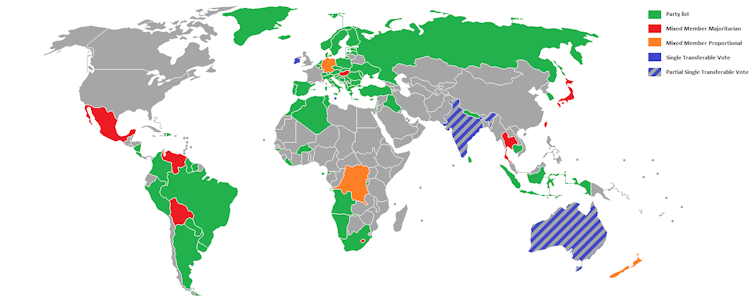
In contrast, U.S. elections award seats on a winner-takes-all basis. The candidate with the most votes wins, while votes cast for candidates representing other parties are ignored. As a upshot, American voters choose their leaders within a de facto two-political party system in which other parties often take trouble even getting their candidates' names onto ballots.
U.S. Greens have won merely a scattering of state-level races, and have never won a congressional seat. Their greatest success came in 2000, when Ralph Nader and Winona LaDuke won 2.7 percentage of the popular vote in the presidential election. Many observers argued that Nader's just real touch on was to throw the ballot to conservative Republican George W. Bush, merely Nader and many of his supporters strongly disagreed, and the question of whether challengers tin human action equally more than spoilers in U.S. elections remains controversial today.
Purity or compromise?
Equally green politicians have helped to shape political priorities in Berlin, Brussels and other European capitals and regions, many observers take debated whether these former activists are selling out past participating in the political procedure – and whether joining that process helps or hurts the green move.
During the 1980s and early 1990s, Green Party conventions in Deutschland were dominated by fierce infighting betwixt moderate "Realos" (realists) and radical "Fundis" (fundamentalists). The Realos, who prioritized electability over ideology, eventually prevailed.
In society to graduate from an opposition party to a ruling party that controlled cabinet posts, German Greens had to develop a capacity for compromise. To gain ability, they had to form coalitions with heart-left Social Democrats. Only coalitions crave consensus – specially in parliaments with proportional representation.
Interacting with centrist politicians, unionists, church representatives and the media taught Realos to act less like activists and more like politicians. In 1998 the Green Party formed a so-called cerise-green coalition with the Social Autonomous Political party (SPD), a party that has traditionally championed the working class, and won a large majority in the Bundestag.
Working through this brotherhood, former activists initiated reform of an blowsy immigration and citizenship law and worked toward recognition of same-sex unions. They implemented an environmentally driven tax code and brokered a bargain with the nuclear energy industry to cancel projects for new plants and phase out nuclear power by 2022.
Many Green Political party supporters thought Realos were besides eager to compromise. Some even physically attacked their party leaders when the coalition government supported use of military force in a NATO-led campaign against Serbia in 1999. Many critics viewed this decision equally the remilitarization of German strange policy under the leadership of Joschka Fischer of the Light-green Party, and so serving every bit Strange Government minister.
However, these compromises did not erode broad public support for the Greens. On the contrary, in 2002 the red-green coalition was reelected and the Green Party received more votes than it had in 1998. When the coalition authorities broke downwards in 2005, it was due to Chancellor Gerhard Schröder's lack of leadership within his own SPD.
Although the Light-green Party has not regained control of Germany's federal regime since 2005, its positions take become part of the nation's mainstream political civilisation. Notably, after the 2011 nuclear establish meltdown in Fukushima, Japan, a centre-right High german authorities decided to accelerate the phaseout of nuclear ability in response to rising public concern. To attain this goal, Angela Merkel's centrist government has implemented an aggressive policy bundle known as the Energiewende that seeks to transition Deutschland to a nonnuclear, low-carbon energy future.
Massive governmental support for alternative energy sources has encouraged Germans, especially in rural areas, to invest in solar ability, wind turbines and biomass plants. These green policies did non impairment, and may take buoyed, Merkel'southward status equally one of the most popular German chancellors prior to this twelvemonth'due south controversies over immigration. Germany reformed its renewable energy law this year in response to new Eu rules governing electricity markets, and volition shift from subsidies to market-based mechanisms, only the Energiewende remains highly pop.
No third lane
At that place is no easy mode for the U.S. Greenish Party to emulate its High german counterparts. Because the American political system makes it difficult for third parties to participate, Green Party candidates do non have opportunities to learn the trade of politics. They have remained activists who are true to their base instead of developing policy positions that would entreatment to a broader audience. By doing so, they weaken their chances of winning major races even in liberal strongholds.
Every bit a result, green ideas enter American political debates simply when Democrats and Republicans take upwardly these bug. Information technology is telling that major U.S. environmental groups started endorsing Clinton even earlier she had clinched the Democratic presidential nomination over Bernie Sanders, who took more aggressive positions on some environmental and energy bug during their main contest. And although Sanders identifies equally an environmentalist, he sought the Autonomous Political party nomination instead of running as the Green Party candidate.
This suggests that running on a third-party ticket in the United States is still non a winning route to shaping a message aimed at a wide electorate. Instead, climatic change, dwindling energy resources and growing human and economical costs from natural disasters will do more than to promote ecological consciousness and political change in mainstream America than the radical rhetoric of the U.S. Green Party.
Source: https://theconversation.com/why-is-the-us-green-party-so-irrelevant-66185
0 Response to "Make America Think Again Green Party"
Publicar un comentario