Did the Italian Mafia Require That Family of Members Be Listed
History of La Cosa Nostra
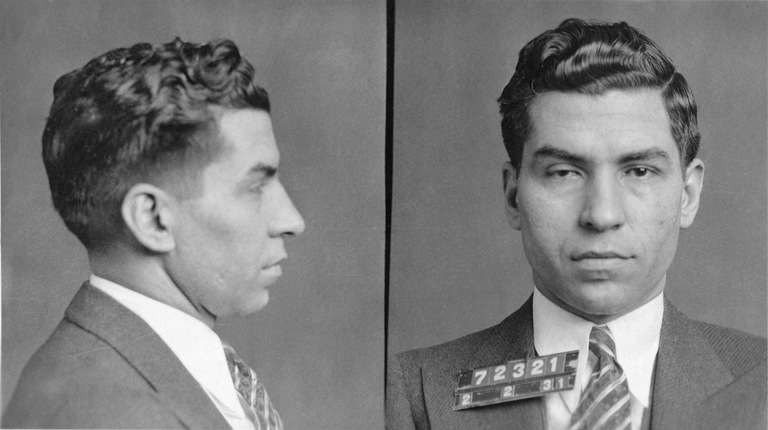
Mugshot of Charles "Lucky" Luciano
Giuseppe Esposito was the outset known Sicilian Mafia member to immigrate to the U.S. He and vi other Sicilians fled to New York afterwards murdering the chancellor and a vice chancellor of a Sicilian province and 11 wealthy landowners. He was arrested in New Orleans in 1881 and extradited to Italy.
New Orleans was also the site of the first major Mafia incident in this country. On October 15, 1890, New Orleans Police force Superintendent David Hennessey was murdered execution-style. Hundreds of Sicilians were arrested, and 19 were eventually indicted for the murder. An acquittal generated rumors of widespread bribery and intimidated witnesses. Outraged citizens of New Orleans organized a lynch mob and killed xi of the 19 defendants. Two were hanged, ix were shot, and the remaining eight escaped.
The American Mafia has evolved over the years every bit various gangs causeless, and lost, authority over the years—for example, the Black Hand gangs around 1900, the 5 Points Gang in the 1910s and '20s in New York City, and Al Capone's Syndicate in Chicago in the 1920s. It was non until 1951 that a U.South. Senate committee led by Democrat Estes Kefauver of Tennessee adamant that a "sinister criminal organization," later known every bit La Cosa Nostra, operated in this nation. Six years later, The New York State Law uncovered a meeting of major La Cosa Nostra figures from around the state in the small-scale upstate New York town of Apalachin. Many of the attendees were arrested. The result was the goad that changed the way constabulary enforcement battles organized crime.
Early History—Masseria and Maranzano
By the end of the '20s, ii primary factions had emerged in the Italian criminal groups in New York. Joseph Masseria, who controlled the groups, sparked the and then-called "Castellammarese War" in 1928 when he tried to gain command of organized crime across the country. The war ended in 1931 when Salvatore Maranzano conspired with Masseria'south top soldier, Charles "Lucky" Luciano, to take Masseria killed. Maranzano emerged as the most powerful Mafia boss in the nation, setting up 5 separate criminal groups in New York and calling himself "Boss of Bosses."
Maranzano was the first leader of the organization at present dubbed "La Cosa Nostra." He established its lawmaking of carry, set upwardly the "family" divisions and construction, and enacted procedures for resolving disputes. Ii of the near powerful La Cosa Nostra families—known today as the Genovese and Gambino families—emerged from Maranzano's restructuring efforts. He named Luciano the starting time boss of what would after be known as the Genovese family. Luciano showed his appreciation less than five months subsequently by sending five men dressed as police force officers to Maranzano's office to murder him.
Luciano, Costello, and Genovese
With Maranzano out of the way, Luciano become the most powerful Mafia dominate in America and used his position to run La Cosa Nostra like a major corporation. Luciano gear up the "Committee" to rule all La Cosa Nostra activities. The Commission included bosses from vii families and divided the unlike rackets amidst the families.
In 1936, Luciano was sentenced to 30 to 50 years in prison for operating a prostitution band. Ten years after, he was released from prison house and deported to Italy, never to return. At that place, he became a liaison between the Sicilian Mafia and La Cosa Nostra. When he was convicted, Frank Costello became acting boss because underboss Vito Genovese had fled to Italy to avoid a murder accuse. Genovese'south render to united states was cleared when a fundamental witness against him was poisoned and the charges were dropped.
Costello led the family for approximately twenty years until May of 1957, when Genovese took control past sending soldier Vincent "the Chin" Gigante to murder him. Costello survived the attack simply relinquished control of the family to Genovese, who named information technology after himself. Attempted murder charges against Gigante were dismissed when Costello refused to identify him equally the shooter. In 1959, information technology was Genovese'due south plow to become to prison following a conviction of conspiracy to violate narcotics laws. He received a 15-year sentence but continued to run the family through his underlings from his prison prison cell in Atlanta, Georgia.
Valachi Sings—and Lombardo Leads
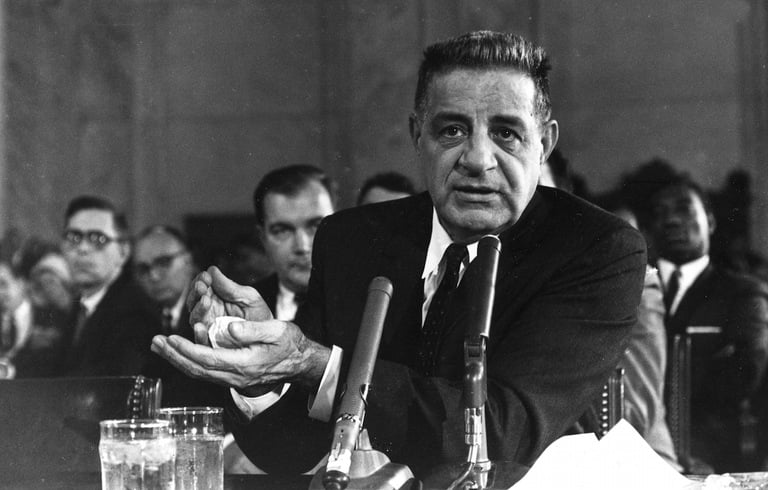
About this time, Joseph Valachi (pictured correct), a "fabricated man," was sent to the same prison as Genovese on a narcotics conviction. Labeled an informer, Valachi survived iii attempts on his life behind bars. Still in prison in 1962, he killed a man he idea Genovese had sent to impale him. He was sentenced to life for the murder.
The sentencing was a turning betoken for Valachi, who decided to cooperate with the U.S. government. Recruited by FBI agents, he appeared earlier the U.Southward. Senate Permanent Subcommittee on Investigations on September 27, 1963 and testified that he was a member of a secret criminal society in the U.Due south. known as La Cosa Nostra. He revealed to the committee numerous secrets of the organization, including its name, structure, power bases, codes, swearing-in ceremony, and members.
In 1969, several years later Valachi began cooperating with the FBI, Vito Genovese died in his prison house cell. Past and then the Genovese family was nether the control of Philip "Benny Squint" Lombardo. Unlike the bosses before him, Lombardo preferred to rule backside his underboss. His showtime, Thomas Eboli, was murdered in 1972. Lombardo then promoted Frank "Funzi" Tieri as his forepart man.
Throughout the 1980s, the Genovese family hierarchy went through several changes. Tieri, recognized on the street as the Genovese family boss in the late 1970s, was convicted for operating a criminal system through a blueprint of racketeering that included murder and extortion. Anthony "Fat Tony" Salerno so fronted as boss until 1985, when he and the bosses of the other four New York families were convicted for operating a criminal enterprise—the LCN Commission. Lombardo, his two captains in prison and his health failing, turned total command of the Genovese family unit over to Gigante—the man who tried to kill Costello 30 years earlier.
Fish on the Hook
In 1986, a second member turned against the Genovese family when Vincent "Fish" Cafaro, a soldier and right-mitt-man to Anthony Salerno, decided to cooperate with the FBI and testify. According to Cafaro'south sworn statement, Gigante ran the family from backside the scenes while pretending to be mentally ill. Cafaro said this behavior helped farther insulate Gigante from authorities while he ran the Genovese family unit'due south criminal activities.
Gigante'due south odd beliefs and mumbling while he walked around New York's East Village in a bathrobe earned him the nickname "the Odd Father." After an FBI investigation, Gigante was bedevilled of racketeering and murder conspiracy in Dec 1997 and sentenced to 12 years. Another FBI investigation led to his indictment on January 17, 2002, accusing him of continuing to run the Genovese family from prison. He pled guilty to obstacle of justice in 2003. Gigante died in prison in Dec 2005 in the aforementioned federal hospital where Gambino family leader John Gotti had died three years before.
The Genovese crime family was once considered the most powerful organized crime family in the nation. Members and their numerous associates engaged in drug trafficking, murder, set on, gambling, extortion, loansharking, labor racketeering, coin laundering, arson, gasoline bootlegging, and infiltration of legitimate businesses. Genovese family members also were involved in stock market manipulation and other illegal frauds and schemes, equally evidenced in the FBI's "Mobstocks" investigation.
Source: https://www.fbi.gov/investigate/organized-crime/history-of-la-cosa-nostra
0 Response to "Did the Italian Mafia Require That Family of Members Be Listed"
Publicar un comentario